9/03/2008

Global Movement for Mental Health: a Well-Paved Road to Hell?


The prestigeous medical journal Lancet launched a campaign to set up a global movement for mental health exactly one year ago. The envisaged movement has two main aims: (1) to scale up the availability of evidence-based treatments for mental health and (2) to ensure full human rights for people with mental health disabilities. The Lancet has been publishing a series on the theme, which gives us more insight on what the campaign initiators really mean under these noble goals. As no one can deny that the aims of the movement are most respectable. Of course, the devil is always in the details.

What are those "details" that make me the devil's advocate in this seemingly laudable effort? Below I am summarising some of my concerns.
  • The keynote of the Lancet articles leaves no doubt that the major focus is the globalisation of Western mental health services and treatments to the developing world. Much is said about evidence based drug treatment and (Western based) community mental health services and nothing, or just negative things are mentioned about the traditional community resources and healing methods available in developing countries, such as India. A famous (and because of the unexpected conclusions, repeated) major WHO study on the comparison between the prognosis of schizophrenia in a number of developed and developing countries has found that the outcome of this major mental health problem is significantly better in the developing world. The Lancet series, and the proposed campaign has not been informed by this finding. Advocating the globalisation of the Western, drug treatment based therapeutic regimes and services, when there is available scientific evidence that in the West major mental disorders have less promising prognosis, seems to be irresponsible.

  • Low and middle income countries are seen as retarded societies and civilizations who need to be emancipated by the Western wisdom. The initiated global movement clearly has not learned from the pitfalls of our Western colonialism. Instead of advocating a global discourse on what mental health is and what resources, methods, frameworks have been developed in various cultures across the globe and over the centuries to promote mental well-being, the movement want to sell the industrialised Western approach.

  • Human rights mostly means the right to treatment in this context. The Lancet series does not reflect upon its own self-contradiction: on the one hand involuntary treatment and hospitalization is mentioned as a human rights concern and source of stigma in the West, on the other hand there is no discussion on the causes of this reliance on force. Without such a deliberation advocating the right to treatment may easily end up in advocating force.
  • Human rights violations in the traditional healing regimes are widely popularised. All this being done without listening to those who voluntarily seek help at traditional healing centers. The fact that no one can be legally coerced to traditional healing, and all human rights breaches taking place in such centers are prosecutable offences, while caging people, depriving them of their liberty and their right to make own choices are backed by mental health laws and thus seen as lawful, is overlooked. Whether the declared full respect for the human rights of people with mental health disabilities is premised on this distinction? Depriving people with disability on grounds non-disabled people would never be lawfully detained is compatible with this "full respect"?
  • The approach adopted by the global movement does not feel a need to seek evidence base for traditional healing. Pioneering scholarly work on the effectiveness of traditional healing, such as the one conducted by the Bapu Trust, is ignored.

  • The entire movement is based on the premise that the task of defining mental health, developing indicators to measure it, is a professional task of the medics. What constitutes evidence is being decided by psychiatrists. Users of services are not seen as central experts in a broad, cross-cultural and multi-sectoral and interdisciplinary (i.e. genuinely global)discourse on what is mental well-being. No need for such a discourse is envisaged, as it is premised that medical professionals in the West and in intergovernmental organisations already know all the basics.

The global movement as it was initiated and as it has evolved so far is not a joint venture of equals. It is a colonisation attempt with hegemonical role and power of the Western industrialised countries, their psycho-pharmacological industry, which, if succeeds will globalise the legitimised human rights violations in the Western mental health sector. It is a hegemonical appropriation of mental health by the medical profession, ignoring the lived experience of the users and survivors of the services.

And this is certainly something that no one can want, who genuinely believes that human rights and human rights of persons with mental health disabilites are not two separate things.

Ganesh Chathurthi: The Largest Festival in Maharashtra

Today a ten-day festival begins, the largest one in Maharashtra. The festival commemorates and celebrates the birth of the elephant headed, most popular deity, Ganesha.

Ganesha or Ganesh is the son of Shiva and Parvati, Ganesha has an elephantine countenance with a curved trunk and big ears, and a huge pot-bellied body of a human being. He is the Lord of success and destroyer of evils and obstacles. He is also worshipped as the god of education, knowledge, wisdom and wealth. In fact, Ganesha is one of the five prime Hindu deities (Brahma, Vishnu, Shiva and Durga being the other four) whose idolatry is glorified as the panchayatana puja.


Significance of the Ganesha Form
Ganesha's head symbolizes the Atman or the soul, which is the ultimate supreme reality of human existence, and his human body signifies Maya or the earthly existence of human beings. The elephant head denotes wisdom and its trunk represents Om, the sound symbol of cosmic reality. In his upper right hand Ganesha holds a goad, which helps him propel mankind forward on the eternal path and remove obstacles from the way. The noose in Ganesha's left hand is a gentle implement to capture all difficulties.

The broken tusk that Ganesha holds like a pen in his lower right hand is a symbol of sacrifice, which he broke for writing the Mahabharata. The rosary in his other hand suggests that the pursuit of knowledge should be continuous. The laddoo (sweet) he holds in his trunk indicates that one must discover the sweetness of the Atman. His fan-like ears convey that he is all ears to our petition. The snake that runs round his waist represents energy in all forms. And he is humble enough to ride the lowest of creatures, a mouse.

How Ganesha Got His Head

The story of the birth of this zoomorphic deity, as depicted in the Shiva Purana, goes like this: Once goddess Parvati, while bathing, created a boy out of the dirt of her body and assigned him the task of guarding the entrance to her bathroom. When Shiva, her husband returned, he was surprised to find a stranger denying him access, and struck off the boy's head in rage. Parvati broke down in utter grief and to soothe her, Shiva sent out his squad (gana) to fetch the head of any sleeping being who was facing the north. The company found a sleeping elephant and brought back its severed head, which was then attached to the body of the boy. Shiva restored its life and made him the leader (pati) of his troops. Hence his name 'Ganapati'. Shiva also bestowed a boon that people would worship him and invoke his name before undertaking any venture.


However, there's another less popular story of his origin, found in the Brahma Vaivarta Purana: Shiva asked Parvati to observe the punyaka vrata for a year to appease Vishnu in order to have a son. When a son was born to her, all the gods and goddesses assembled to rejoice on its birth. Lord Shani, the son of Surya (Sun-God), was also present but he refused to look at the infant. Perturbed at this behaviour, Parvati asked him the reason, and Shani replied that his looking at baby would harm the newborn. However, on Parvati's insistence when Shani eyed the baby, the child's head was severed instantly. All the gods started to bemoan, whereupon Vishnu hurried to the bank of river Pushpabhadra and brought back the head of a young elephant, and joined it to the baby's body, thus reviving it.

Ganesha, the Destroyer of Pride

Ganesha is also the destroyer of vanity, selfishness and pride. He is the personification of material universe in all its various magnificent manifestations. "All Hindus worship Ganesha regardless of their sectarian belief," says D N Singh in A Study of Hinduism. "He is both the beginning of the religion and the meeting ground for all Hindus."

Ganesh Chaturthi

Birthday of Lord Ganesh is one of the most popular Hindu Festival. It is celebrated on the 4th day (chaturthi) of the bright fortnight month of Bhadrapada (August-September) in Hindu Calendar. The celebration continues till Anantha Chaturdasi which is for 10 full days.

There are interesting stories associated with Ganesh Chaturthi and its significance. One of the most popular legend found in Skanda Purana says, once Ganesha was invited for a feast in Chandralok. The joyous Ganesh feasts himself to his heart's content. But he grows very restless and feels that his stomach would burst out. In order to prevent the stomach from bursting out, he ties a snake around it. But he was not able to balance himself after the huge meal and stumbles and falls. The moon watches the scene from the sky and laughs at Ganesh.

Angered, Lord Ganesh curses the moon to vanish from the universe. However because of the moon's absence, the whole world began to wane. So the gods asked Shiva to persuade Ganesha to relent. The moon also apologized for his misbehavior. On Shiva's intervention, Ganesha modified his curse. He announced that the moon would be invisible on only one day of a month, and would be partially seen for the Ganesha Utsav most part.

On the occasion of the Ganapati festival a large number of images are made of all possible sizes, and people buy them to keep in their houses as a divine guest for one and a half, five, seven, or ten days. On the day of the Chaturthi, shrines are erected, firecrackers let off, huge images of Ganeshji are carried in grand procession for 'Ganesh Visarjan' accompanied by the sound of devotional songs and drums. The idol should not be kept after this day, as it is considered inauspicious.

The festival culminates on the day of Ananta Chaturdashi, when images (murtis) of Ganesha are immersed in the most convenient body of water. In 1893, Lokmanya Tilak transformed this annual Ganesha festival from private family celebrations into a grand public event. He did so "to bridge the gap between the Brahmins and the non-Brahmins and find an appropriate context in which to build a new grassroots unity between them" in his nationalistic strivings against the British in Maharashtra. Because of Ganesha's wide appeal as "the god for Everyman", Tilak chose him as a rallying point for Indian protest against British rule. Tilak was the first to install large public images of Ganesha in pavilions, and he established the practice of submerging all the public images on the tenth day. Today, Hindus across India celebrate the Ganapati festival with great fervour, though it is most popular in the state of Maharashtra.


I have my own baby Ganesha, who, on the occasion of a prosaic shopping several times fell into my shopping basket. Then I understood that he wanted to come with me.

Amita's brother has a beautiful art gallery in Chennai with a particularly rich collection of Ganesha idols. Most of the photographs in this entry were taken in his gallery.

9/02/2008

New Template for the Blog

As the first half of my India programme expired, I decided to change the template of the blog. I also included a new facility that will enable readers to easily email some of the blog entries to their friends.

Can User/Survivor Advocacy Learn from Indian Tradition?


It would be hard to deny that current user/survivor advocacy has been very much shaped by the American (or Anglo-Saxon?) advocacy traditions. This approach has resulted in a number of achievements, we, user/survivor advocates can rightly be proud of. But certainly this approach has its limits. It looks like the American/Anglo-Saxon way reached its limits. After decades of advocacy we are not much closer in eradicating force from psychiatry. Some of my colleagues, especially from the States expect significant changes from the UN Convention on the Rights of Persons with Disabilities. It is a shame that it is most unlikely that the US will sign, let alone ratify CRPD in the foreseeable future. My position is that CRPD is a good basis but only if we can innovate our advocacy philosophy.


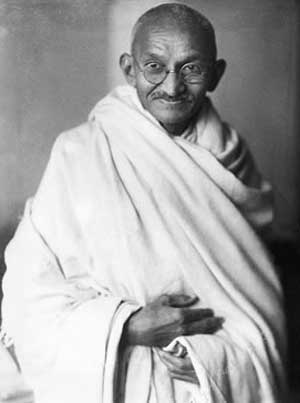
Martin Luther King went to India to learn from their tradition before launched their civil rights movement. Can we also learn something timely from the Indian tradition? After three months in India and after numerous discussios on Gandhi and the Freedom fight with Amita and many colleagues, and after reading on the topic and from the leaders of the Indian freedom fight, my proposal is that yes, we can learn a number of timely lessons that may help utilize the opportunity brought by the entry into force of the CRPD.

I state that Gandhi's most important advocacy principle was not the principle of non-violence, as many of us believe. While non-violence has been enormously (and for the West most unexpectedly) powerful, the Gandhi follower Mandela, who emphasised the superior value of non-violence, had resumed to violence on occasions. This was not in contradiction with Gandhi himself, as he had written: "'that where there is only a choice between cowardice and violence, I would advise violence". Simlarly, I am advocating for non-violent user/survivor advocacy, but together with Gandhiji's precaution. I think Gandhi's major advocacy innovation was that he was able to present the concepts of freedom and liberty in a language and historical context that was natural and easy to understand for Indians. Through presenting these ideals and goals as inherently Indian ones he managed to convince masses to follow the route and adopt also the non-violence principle.

What this may mean for our current day user/survivor advocacy is that we need to learn how to present CRPD in the language and historical context of the user/survivor culture. So far most of the advocacy efforts have started from CRPD and explain what it means for users/survivors. What the Gandhiji tradition tells me is that we need to follow the opposite way: let us go back to the user/survivor culture and link the values discoursed there with the CRPD. Then we can mobilise much more users/survivors than following the "let us translate CRPD to user/survivor language" approach.


Another proposal I am making based on my lessons in the Indian tradition is that we both need to mobilise our peers to become their own advocates, as the father of the Constitution of India, dr Ambedkar did with the dalits AND to change the hearts of the majority society, as Gandhiji did with caste Hindus. Self-gettoing is an ever-present danger in any marginalised groups advocacy movement, and this twin-track approach can help us prevent it.

Sources for the photos:

  • Gandhi: http://www.khaasbaat.com/may2007/images/may07/gandhi.jpg
  • King: Library of Congress. New York World-Telegram & Sun Collection. http://hdl.loc.gov/loc.pnp/cph.3c26559 Date=1964 Author=Dick DeMarsico, World Telegram staff photog
  • Ambedkar: http://www.unm.edu/~rhayes/ambedkar.jpeg

Legal Advocacy in Mental Health - a Concept Note


The adoption and recently the entry into force of the UN Convention on the Rights of Persons with Disabilities have generated unprecedented interest in legal advocacy in mental health. What has been a professional interest of a marginally few will and should become a public concern if we want CRPD to be more than a failed promise.


But what does legal advocacy mean? And what does it mean in the field of mental health? These are hitherto unanswered questions.


Advocates can also benefit from the old Hippocratic maxima: Cause no harm. The likelihood of causing unintended harm is non-negligible if conscoius reflection on the basic questions is missing.


That is why Amita Dhanda and I developed a concept note and have started elaborating it. Here comes the concept note.


Legal Advocacy : Concept Paper
Questions arising in Legal Advocacy
· What is meant by Advocacy?
· What is the purpose of Advocacy?
· Where do we situate the user – survivor
· The prioritization between stakeholders – psychiatrists, caregivers.
What is meant by Legal Advocacy?
- Filing test cases
- Client centered Legal Advocacy
- What should dictate the filing: the possibility of winning or the needs of the client.
- The travails of varied opinions between u/s groups in the process of consultation for law reform
- How should the varied opinions of different groups be addressed in law reform exercises?
- At present the differences are being handled on a cats& monkey strategy , necessary to ask how should negotiation be undertaken and resolution obtained?
- How to ensure that the consultation of stakeholders is a real and not a symbolic one?
What to do with litigation outcome?
- You may never get the perfect result – do only a press release but ignore the counter position
- What should be the principles?
What else beside litigation should fall under legal advocacy?
How to reach people to convince them that they have rights but those rights to be real require assertion. So what innovative means and methods should be employed to reach the concerned people?
This of course also raises the question as to who are the concerned people? Is only a person living with MI a concerned person? Or should this information be disseminated to society at large as in effect everyone is a concerned person?
Destigmatization through legal advocacy
One body of opinion that litigation and advocacy should be grounded in present law? If that line taken then what do you do about the entire body of legal rulings/ principles/ precedents which have been arrived at by a prejudicial understanding of Persons living with Mental Illness.
Important to appreciate that legal advocacy in mental health is not a choice. Cannot begin from the social end of the discrimination as the challenge to social discrimination can be rendered null at any point by legal discrimination. In the wake of this reality that the above stated questions have to be addressed.

Human Rights and the Right to be Human


The title of this article I borrowed from Prof. Upendra Baxi, though I may use it in a different sense. I have been thinking a lot about prejudices. For the first time in my life I have been staying in a part of the world where white people are a minority. In addition, the role they played in the history of the country is highly controversial. After many years I had the exposition to a huge number of professionally trained (biased?) psychiatrists, whose training can easily make them sanists. Every now and then I face ableism. Many of my friends have been activists or beneficiaries of feminism, so I became quite aware of sexism...


One is tempted to raise the question if it is possible at all to be free from these and many other "-isms"? This question is more urging if we work in the field of human rights.


I don't believe that anyone can be absolutely free of prejudices. If someone tells me he/she has no prejudices, I frankly don't believe it. And I don't think I am cynical. It may happen that we are unaware of (some) of our prejudices. But remember: unconscious prejudices are the most dangerous, the most killing ones.


Fairness and common sense reasoning requires that we admit our prejudices. Our vulnerability. Only then have we chance to fight them.


I met many human rights activists and scholars who were eloquent anti-racists, or feminists, etc. and still when speaking about "mentally ill" people, that is about me, forgot about the universality and indivisibility of human rights and thought it is just legitimate to deprive me of my liberty, of my equality before the law, etc on the ground of my disability (maybe in conjunction with some other attribute).


Human rights, if we take it seriously, is about a world without prejudices. But human rights activists are human beings and share all human vulnerabilities, including prejudicial thinking. And the more intelligent a human is, the more easily can rationalise his/her prejudices. Human rights activists are not necessarily the least prejudiced people.


We need to know that a rigid distinction between me and non-me automatically leads to prejudices. But how can we, if at all, go beyond that distinction? Just knowing that every one of us is equal and this means both same and different, is insufficient. Social psychological defence mechanisms, such as cognitive dissonance prevent us from conducting ourselves in accord with this knowledge whenever highly marginalised groups are at stake. Honestly, what do you feel and think when pass a homeless person in the street?


I had the privilege to feel and live that the 6 billion of us is just one being. Yes, this happened in a psychotic episode. Or it resulted in a psychotic crisis? The experience was wonderful but too much.


Knowing that all we are one seems to be insufficient, feeling and living it seems too much. Is there a way out? Prof. Baxi's phrase on human rights and the right to be human can be useful. Let us think about it. And let us feel about it.

Source of the photo of Siquerios' paitning entitled The March of Humanity:
Jason & NathaliePhotographer: Jason & Nathalie From: The story of D.F.

9/01/2008

India-Taoism-and Me: an even more subjective mid-term evaluation


The previous evaluation was subjective - and superficial. It remained on the surface, described various activities as if they were isolated, non-interfering, non-interacting. This is certainly not the case. Likely the most important feature of my first three months in India has been interaction. Or the lack of it. Or where to draw the line between me and non-me. Where and when and how to say no to interaction. Where and when and how to become angry, sad, depressed, mad for facing walls not allowing me to interact. And finally, can I not interact with myself? Can activities where I have been involved in be non-interacting if I, per definitionem, am interacting with myself?


If you want to disappear, go to a country which is huge, diverse, crowded. Go to India, for instance. If you want to meet yourself without any chance to escape from yourself, go to India. For instance.


I had known, before I came here, that I shall be meeting myself. Noone, even myself can prevent me from that. I had wanted that.


Now, it has happened. I am facing myself. I see myself from the outside. I am dissatisfied. This me has nothing to do with any of the personae attributed to me.


This three months gave a stage for many of my personae. The physicist. The human rights defender. The poet. The user/survivor activist. The teacher. The colleague. The philosopher. The friend. The lover. The cook. And so on... The cured mentally ill foreigner.


Each persona has a justification and a legitimacy to exist. Thus none of them, no superposition of them, no masala of them can barely approximate the one who is staring at me. Almost wrote: the real me. Be cautious, this is already dangerous.


None of them and no combination of them can describe GG who has been constructed on illegitimacy. Whose deeper identification has been rooted in being an illegitimate child. Whose birth was welcomed only by two people. One committed suicide. The other died much later, as a victim of an involuntary medical experimentation.


Illegitimacy demands for justification. Illegitimacy cannot be justified.


Do I want to be myself? If yes, why do I pretend to be some of my personae? Why do I, who values autonomy stronger than anything, want to behave according to others' expectations? Why am I telling lies instead of truth when hiding my emotions? When making secret of very simple and good feelings? To comfort others, why? How can I speak truth to power on the rights of persons with disabilities then?


Why can I not go with the flow, if I understood and learned through painful lessons that it is the way to go? Why do I want to do and to have things instead of just being? How can I teach about the healing power of being with the other if I cannot be?


Why do I hate myself when I know that this is destruction? That I cannot love anyone if hate myself?


Why do I want to do something with my wounds instead of letting them be healed?


Why do I internalise those people's hatred who collected money for an abortion to prevent my birth?
How can I advocate human rights if I do not believe that I am entitled to them?


Why can I not exercise wu-wei? Of which I had already written as a physicist.


Wu-wei is: "The writings of the legendary Taoist sages, Lao Tzu and Chuang Tzu, furnish us with specific principles as a guide to attaining this state of oneness. Through understanding these principles and applying them to daily living we may consciously become a part of life's flow.A key principle in realizing our oneness with the Tao is that of wu-wei, or "non-doing." Wu-wei refers to behavior that arises from a sense of oneself as connected to others and to one's environment. It is not motivated by a sense of separateness. It is action that is spontaneous and effortless. At the same time it is not to be considered inertia, laziness, or mere passivity. Rather, it is the experience of going with the grain or swimming with the current. Our contemporary expression, "going with the flow," is a direct expression of this fundamental Taoist principle, which in its most basic form refers to behavior occurring in response to the flow of the Tao.The principle of wu-wei contains certain implications. Foremost among these is the need to consciously experience ourselves as part of the unity of life that is the Tao. Lao Tzu writes that we must be quiet and watchful, learning to listen to both our own inner voices and to the voices of our environment in a non-interfering, receptive manner. In this way we also learn to rely on more than just our intellect and logical mind to gather and assess information. We develop and trust our intuition as our direct connection to the Tao. We heed the intelligence of our whole body, not only our brain. And we learn through our own experience. All of this allows us to respond readily to the needs of the environment, which of course includes ourselves. And just as the Tao functions in a manner to promote harmony and balance, our own actions, performed in the spirit of wu-wei, produce the same result.Wu-wei also implies action that is spontaneous, natural, and effortless. As with the Tao, this behavior simply flows through us because it is the right action, appropriate to its time and place, and serving the purpose of greater harmony and balance. Chuang Tzu refers to this type of being in the world as flowing, or more poetically (and provocatively), as "purposeless wandering!" How opposite this concept is to some of our most cherished cultural values. To have no purpose is unthinkable and even frightening, certainly anti-social and perhaps pathological in the context of modern day living. And yet it would be difficult to maintain that our current values have promoted harmony and balance, either environmentally or on an individual level.To allow oneself to "wander without purpose" can be frightening because it challenges some of our most basic assumptions about life, about who we are as humans, and about our role in the world. From a Taoist point of view it is our cherished beliefs - that we exist as separate beings, that we can exercise willful control over all situations, and that our role is to conquer our environment - that lead to a state of disharmony and imbalance. Yet, "the Tao nourishes everything," Lao Tzu writes. If we can learn to follow the Tao, practicing non-action," then nothing remains undone. This means trusting our own bodies, our thoughts and emotions, and also believing that the environment will provide support and guidance. Thus the need to develop watchfulness and quietness of mind." (Taoism - The Wu-Wei Principle, Part 4 by Ted Kardash, http://www.jadedragon.com/archives/june98/tao.html)


Why can I not be a whole? Why do I want to escape? Why am I so weak? Who will stop me?


Is there a meaning in these at all?